
Organizational Leaders and the Incompetence Myth
When I talk with CEOs I often hear some version of the same thing:
Why do all my leaders suck?
Why does my leadership team feel like a collection of functions rather than a well oiled unit?
Why do I have to keep hiring or changing out my VP of Engineering every year or two?
The underlying theme? “I think I have the wrong leaders.”
They’re wrong. Not about the problem. The problem is real. But about what’s causing it.
What looks like incompetence is almost always something more specific and more fixable: leaders who were trained for one kind of work, rewarded for one kind of work, and then placed into a wholly different role with completely different expectations, competencies, and terrain without anyone naming that shift or preparing them for it.
They can feel it. They just don’t have the language.
The reason is that the framework most of us are still using is broken. For decades, the dominant distinction in leadership has been management versus leadership. Managers do things right, leaders do the right things. Warren Bennis gave us a tidy list of binaries: managers administer, leaders innovate. Managers maintain, leaders develop. Managers focus on systems, leaders focus on people.
That last one in particular really doesn’t land for me. Organizational leaders are deeply systems-oriented — they’re just managing a different kind of system. Not a technical system or a functional one. The organization itself, its people, its culture, its moving parts.
The management versus leadership distinction is a false binary. It implies you either manage or you lead and sometimes people do both. Some organizational leaders don’t manage anyone at all. It collapses two completely different kinds of work into one category and leaves leaders without a map for what actually changes when they move into organizational roles. That’s the gap the Leadership Domains framework was built to fill.
Leadership role × leadership work
Here’s what I tell CEOs when they come to me with this problem.
I’m not sure we have the wrong leaders on the team. We might but it’s worth taking a deeper look first. What I think we have is something that’s gone unarticulated. We need language for it.
The problem may not be incompetence. It’s likely to be a domain problem. Meaning, leaders operating at the wrong altitude. There are likely organizational leaders who are operating way too deep in their function. They’re protecting their team. They’re tending to their function. But what they’re missing is the connective tissue between them and other teams. They’re missing the entire organizational system and their role in it which is much bigger than their functional expertise.
That’s the distinction this framework is built on — the difference between functional leadership and organizational leadership. It starts with separating two things we constantly collapse together: leadership role and leadership work.
A title does not determine the kind of leadership work someone is doing at any given moment. What matters is the scope of the decisions being made, the level of integration required, and the consequences of getting it wrong.
When we separate role from work, four distinct patterns emerge.
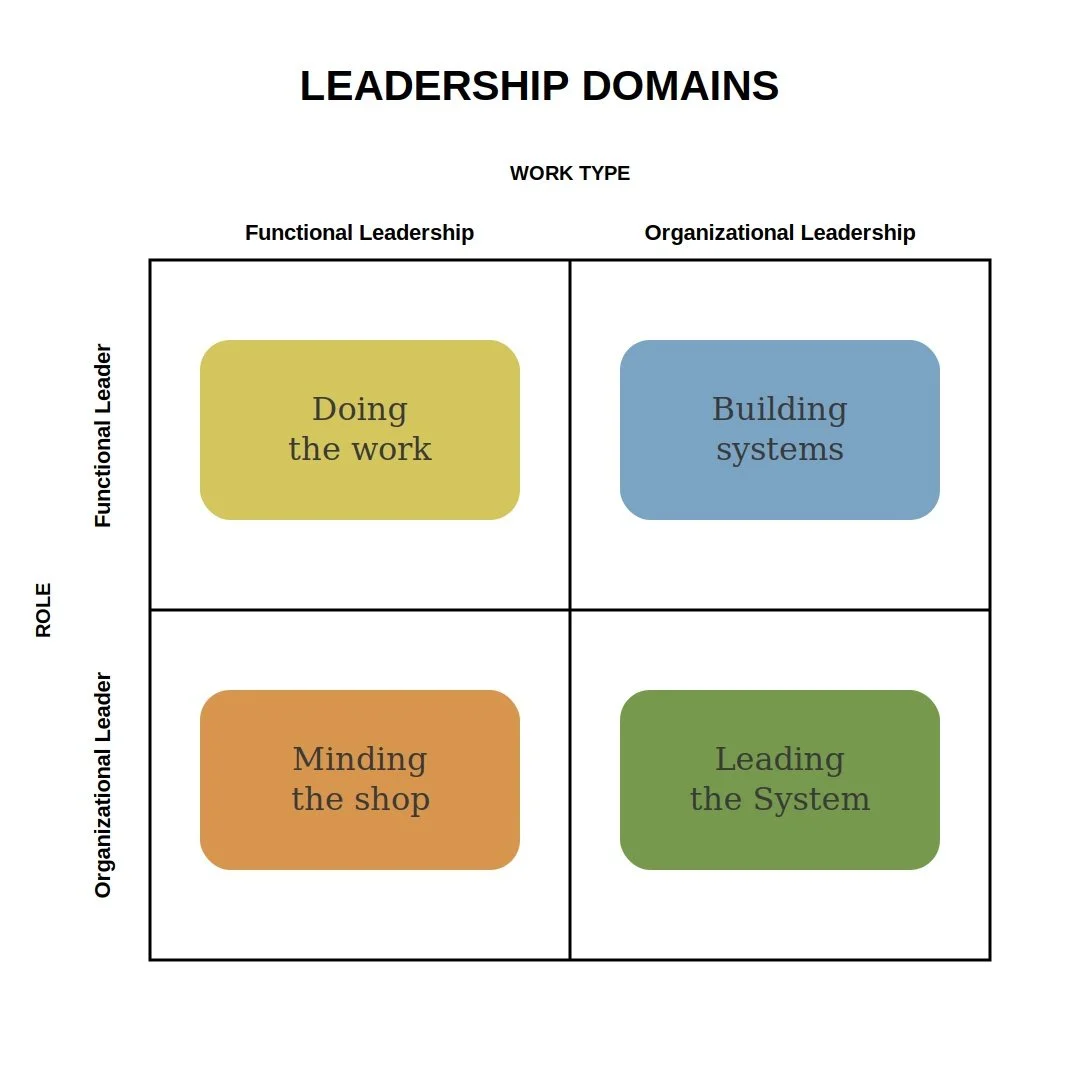
Doing the Work
Functional leader doing functional leadership work
This is where most managers and senior managers spend the majority of their time. Functional leaders doing functional work are focused on:
Managing teams and individual contributors
Executing deliverables and running day-to-day operations
Applying domain expertise to tactical problems
Ensuring functional outcomes are met
This work is concrete, execution-oriented, and close to the ground. It keeps the organization operating. There is nothing wrong with this quadrant, companies depend on leaders doing this work well. This quadrant matters because it gives us language. Without a clear picture of what functional leadership actually is, we can’t see what changes when leaders move into organizational roles. That’s where the confusion starts. We often assume that doing this work well prepares someone for what comes next. It doesn’t. It prepares them to be excellent functional leaders. Organizational leadership is an entirely different domain.
Building Systems
Functional leader doing organizational leadership work
These are functional leaders who are starting to outgrow their role or those in a flatter orgs. They’re beginning to work beyond their function. They’re starting to work more at the system level. They see other functions not as adversaries, not as competition for resources, not as roadblocks, but as parts of a system that genuinely has to work well together. Something shifts in how they see their value. They begin to realize that collaboration is far more effective than protection. That hoarding resources for their function is actually working against them. That their impact is bigger when they’re thinking about the whole, not just their piece of it.
This is organizational leadership work, even when it’s being done by someone without an organizational title. It can also be some of the most invisible work in organizations. They may not be rewarded or recognized for it. There isn’t language for it. Many of these leaders get promoted into Director and Head roles without anyone recognizing what they’ve already been doing or building on it intentionally. The transition might happen, but the development may not. And nobody names the most important thing: that they haven’t just gotten a new title. They’ve entered an entirely different domain.
Minding the Shop
Organizational leader doing functional leadership work
Organizational leaders will always do some functional work. That’s not the problem. A more common problem is the ratio between functional and organizational work.
There are times when it makes sense for organizational leaders to move closer to the functional work. Like when a leader on your team is missing. When the company is pivoting. When you’re in a period of rapid change or the organization is under-resourced. In those moments the ratio shifts and that’s appropriate.
This might look like:
Staying close to functional strategy
Overseeing critical deliverables
Communicating key projects and initiatives
Being more hands on with succession planning
The cracks start to show when the ratio tips too far. When organizational leaders are spending the majority of their time in this quadrant — tending to their function, staying in the weeds, managing up close — the organizational work goes undone. We get misaligned. The connective tissue between functions starts to fray. Organizational leaders who stay too close to the work unintentionally slow the system down. Decisions slow. Functional teams experience their involvement as micromanagement.
Often these are the leaders who get labeled incompetent. Not because they’re incapable, because they’re spending the majority of their time at the wrong altitude for the role they hold.
Without language for this shift, leaders blame themselves. Organizations blame the leader. And the pattern repeats.
That’s not a style problem. That’s a domain problem.
Leading The System
Organizational leader doing organizational leadership work
This is where organizational leaders should spend most of their time. It’s easy to spot them.
They’re the leaders whose focus is more broad and future-oriented rather than function-focused or this-quarter focused. They spend as much time, often more, outside their function as they do within it. They’re not just tending their piece of the organization — they’re thinking about how all the pieces fit together.
When they come to a decision they don’t lead with their function as the primary lens. Their function is one perspective, one puzzle piece. What they’re focused on is building the picture.
This work includes:
Partnering with peers on organization-wide strategy
Aligning across functions to reduce friction and duplication
Minding the organizational system
Guiding initiatives that cut across teams and stakeholders
This work is often less visible than execution. It doesn’t always show up in a sprint review or a quarterly report, but its impact is far greater. When this work is done well organizations gain momentum. When it’s neglected the org might feel busy but brittle, moving fast without actually moving forward.
Why New Directors and Heads Struggle
The transition into organizational leadership is often one of the least-supported shifts. New Directors and Heads of flail not because they lack ability. They flail because we haven’t introduced them to the new terrain. They may not realize they’re on new terrain at all. This means they don’t realize the role requires a fundamentally different set of skills and mindsets. They don’t have language for what’s now expected of them. They were handed a new title and new accountability — but not a map.
So these new organizational leaders do what they know. They drive into their function. They do the work they were rewarded for. They become functional rock stars in organizational leadership roles. Eventually they get labeled as incompetent or failing.
Here’s the thing. When we don’t introduce leaders to the domain they’ve just entered — when we don’t name the terrain, set the expectations, or build the skills — the organization has failed them. Not the other way around. This is predictable and preventable.
When leaders and organizations finally have this language something shifts. The CEO who thought they had an incompetence problem starts to see something different — leaders who are untrained and ill prepared for a wholly different kind of work. Leaders who were never given the map for the terrain they’re now in. Leaders who drove deep into their function because that’s what they knew, that’s what they were rewarded for, and nobody told them the job had changed. That shift changes everything downstream. They invest in developing leaders instead of cycling through them. They make different hiring decisions — looking for organizational skills, not just functional rock stars. They change what they actually expect from leaders at each level and name those expectations out loud.
The leadership team stops feeling like a collection of functions with everyone pulling in different directions. It starts feeling like gliding across the lake — moving in harmony, building momentum together. That’s what becomes possible when you stop calling it an incompetence problem and start calling it what it actually is: leaders operating in the wrong domain.