
Four Territories of Leadership
A Constellary Framework
Organizational friction isn't always a people problem. It's a land problem — though it rarely gets diagnosed that way.
At the organizational level, the hardest work doesn't happen inside functions — it happens in the spaces between them. Organizational leaders are constantly navigating territory that isn't clearly theirs, someone else's, or anyone's at all. Without a way to diagnose what kind of territory they're in, they apply the wrong approach and friction that could be productive becomes stuck or destructive instead.
People and relationships matter. But far more organizational tension than we realize comes from leaders not knowing what kind of land they're standing on.
How This Framework Came to Be
Our founder Suzan Bond spent years as a COO and leadership consultant watching capable leaders flail after being promoted into organizational roles. They weren't struggling because they lacked ability. They were struggling because no one told them the territory had changed.
As functional leaders they had clear domain. Clear authority. Success meant executing well within their area. But at the organizational level, the most important work happens in the spaces between functions, territory that requires a completely different approach. Most new organizational leaders don't realize this. They keep operating as if they're on functional land when they're actually on shared, conflicted, or unclaimed land. And they expect a level of autonomy that the new role simply doesn't offer.
The result is predictable. They make decisions unilaterally that require collaboration. They experience friction they don't know how to diagnose. They feel frustrated by constraints they weren't expecting. And the organization feels the drag of leaders operating at the wrong altitude on the wrong kind of land.
The Four Territories of Leadership framework came out of that observation. It gives organizational leaders — particularly those new to the role — a way to see the territory they're actually in, understand why it requires a different approach, and navigate it more effectively from the start.
Four Territories of Leadership
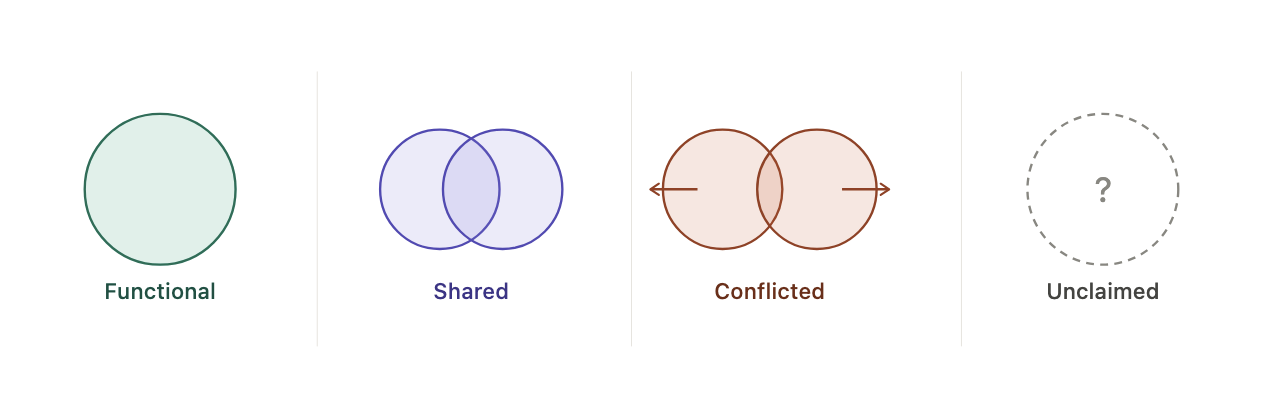
Every decision, initiative, and challenge in an organization lives in one of four types of territory. Understanding which type changes everything about how to approach it.
Functional Territory
Territory where one leader has clear authority and accountability. Decisions stay within one function. At the organizational level this land is much smaller than most leaders expect — and one of the most common mistakes new organizational leaders make is assuming more territory is functional than actually is.
Shared Territory
Territory where multiple functions must collaborate because the work, decisions, or outcomes genuinely belong to more than one area. This is where organizational leadership actually happens. It requires advocating strongly for a perspective while remaining genuinely open to others' views — and living with the discomfort of not having final say while still being accountable for outcomes.
Shared territory creates friction by design. Leaders are supposed to have different perspectives — that's why multiple functions need to be involved. That friction, when navigated well, produces better decisions than any one leader could make alone.
Conflicted Territory
Shared territory that has become contentious due to unclear ownership, competing priorities, or relationships that can't hold the weight of disagreement. When conflicted territory goes unresolved it creates organizational debt — trust erodes, back-channel conversations replace direct ones, and what started as a strategic disagreement becomes personal. Eventually even simple decisions become battles.
The distinction between productive shared territory and destructive conflicted territory isn't the presence of disagreement. It's how that disagreement gets handled.
Unclaimed Territory
Territory that falls between functions with no clear owner — often because it's ambiguous, uncomfortable, or doesn't fit neatly into anyone's job description. Unclaimed territory doesn't just create inefficiency. It creates missed opportunities, degraded customer experience, and stalled initiatives. The cost isn't always visible in the moment but it compounds over time.
Why This Matters
Most leadership development focuses on individual capability — how to think strategically, how to develop a team, how to communicate effectively. All of that matters. But it doesn't prepare leaders for the most important shift that happens at the organizational level: the work is no longer primarily inside their function. It's in the territory between functions.
New organizational leaders who don't understand the four territories tend to make the same mistakes. They claim functional authority over decisions that require collaboration. They experience shared territory as a threat rather than the place where the real work happens. They avoid conflicted territory instead of navigating it directly. They ignore unclaimed territory until it becomes a crisis.
None of this is a character flaw. It's a preparation gap. Leaders can't navigate territory they don't know exists.
The impact doesn't stay contained to individual leaders. When multiple leaders on an executive team are misreading the territory — operating on functional autopilot in shared land, leaving conflicted territory unresolved, ignoring what's unclaimed — it compounds. Leadership team meetings become tense or unproductive. Decisions stall. Collaboration breaks down across the whole system. What starts as an individual leader's struggle becomes an organizational drag that the CEO and People leaders feel acutely.
When organizational leaders can see the territory clearly — when they know what kind of land they're standing on and what it requires — the friction doesn't disappear. But it becomes productive rather than destructive. Decisions get made. Collaboration improves. And leaders stop feeling surprised by the complexity that comes with the role.
Working With This Framework
Constellary uses the Four Territories of Leadership framework as a diagnostic in coaching and leadership team work. It helps organizational leaders — particularly those new to the role — identify what kind of territory they’re operating in and adapt their approach accordingly.
In one-on-one coaching it gives leaders language for the friction they’re experiencing. Rather than attributing difficulty to relationships or personalities, they can start asking a more useful question: what kind of land am I on, and am I treating it the right way? That reframe alone often changes the quality of the conversation and the decisions that follow.
In offsites and leadership team work the Four Territories of Leadership framework surfaces patterns that are usually felt but rarely named. Where is the team spending most of its time? How much is stuck in conflicted territory? What’s being left unclaimed that no one is addressing? Making those patterns visible creates the conditions for more honest and productive conversations about how the team is actually operating.
Related Reading
Going deeper on the Four Territories of Leadership
∙ Mine, Yours or Ours? Navigating Organizational Land
∙ The Functional Rock Star Myth
∙ Finding Dysfunction in Your Org
Ready to explore how this framework applies to you or your organization?