
Organizational Debt
A Constellary Framework
When strategies stall, results slow down, or change efforts lose momentum, the issue is rarely effort. It's usually organizational debt — the hidden patterns that quietly shape how decisions get made, how work happens, and how change unfolds.
Constellary’s organizational debt framework gives leaders a way to identify where debt has built up and where to focus so the organization can move forward with less friction.
How This Framework Came to Be
Our founder Suzan Bond first noticed organizational debt when she was a COO at a startup. Like most growing companies, they were focused on surviving and growing, which meant we poured energy into executing and under-invested in the organizational side of the business. Over time, leadership strain, relational breakdowns, and unrealistic planning piled up — and those hidden costs started getting in the way of the very results we were chasing.
Later, as a leadership consultant, she saw the same pattern again and again across different organizations. Leaders were dealing with stalled progress, culture friction, and change efforts that wouldn’t stick, but they didn’t have good language for what was really going on. People would say “org debt,” but it was a catch-all. Without clearer categories, it was hard to see what kind of debt was building or how to address it.
Constellary’s Organizational Debt Framework grew out of that gap. It gives leaders a way to name different types of organizational debt, understand how they build up, and intervene earlier — before those debts snowball into major obstacles. And it opens the door to a more honest conversation about trade-offs: not just how do we reduce debt, but what kinds of debt are we consciously choosing, and for how long?
The Five Types of Organizational Debt
Organizational debt is the hidden cost of past decisions about people, processes, and structure that no longer fit the organization you are today. It’s the interest you pay on decisions your organization has outgrown. And unlike financial debt, it rarely shows up on a dashboard — it shows up in friction, delays, and change efforts that never quite land.
Leadership Debt Leadership debt creates a ceiling on organizational performance. It's the accumulated cost of leadership capabilities, roles, and support structures that haven't kept pace with what the organization now requires. It builds when expectations of leaders grow, but development, clarity, and infrastructure do not. The result: Leaders become overloaded, decision quality declines, and the organization hits a performance ceiling it can't push past.
Relational Debt Relational debt freezes the organization's ability to solve complex problems. It's the accumulated cost of strained, neglected, or transactional relationships at work. It builds as trust, goodwill, and psychological safety erode through misalignment, poor communication, and unresolved conflict. The result: People become more guarded, collaboration weakens, and the organization loses its ability to tackle hard, cross-boundary challenges.
Reality Debt Reality debt disconnects strategy from execution capacity. It's the growing gap between what the organization says it can do and what it can actually deliver. It accumulates when new priorities are added without removing old ones, when everything is labeled "critical," and when leaders avoid making real trade-offs. The result: Over-commitment becomes the norm, teams burn out, and strategic goals consistently stall in execution.
Systems Debt Systems debt forces people to fight outdated processes instead of adding value. It's the accumulated cost of inefficient, manual, or poorly integrated processes and tools. Over time, workarounds, duplications, and duct-tape solutions pile up and become the default way of operating. The result: Work slows down, frustration rises, innovation becomes harder, and scaling the organization becomes increasingly difficult.
Structural Debt Structural debt limits scalability and creates unsustainable leadership loads. It's the accumulated cost of org charts, reporting lines, and decision structures that no longer match how work actually happens. It builds gradually as organizations evolve without redesigning their structure to fit their new reality. The result: Accountability blurs, decision bottlenecks grow, and leaders carry unsustainable spans of control.
These are high-level summaries. For a deeper look at each type — including signs and real-world examples — read the full article on the Five Kinds of Organizational Debt.
👉 Read the full article on the Five Kinds of Organizational Debt
The Organizational Debt Hierarchy
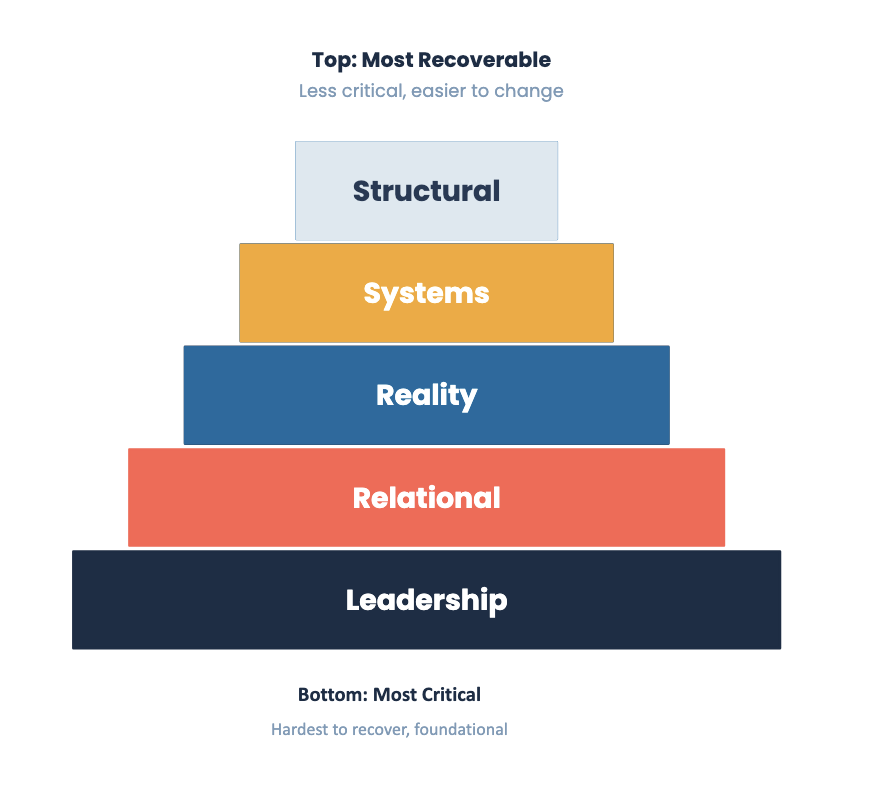
Not all organizational debt has the same impact — or the same path to recovery. Some forms sit closer to the surface and are easier to address. Others are deeper, more foundational, and take longer to shift because they shape how leaders think, relate, and make decisions. The hierarchy shows how different types of organizational debt stack and influence one another. Debt lower in the system tends to be more critical and harder to recover from, while debt higher up is often more visible and easier to change. Understanding these layers helps leaders focus their efforts where they’ll have the greatest long-term impact — not just the quickest short-term fix. Structural Debt — Most visible, most recoverable. Org charts and reporting lines that no longer match how work actually happens.
Systems Debt — Lives in processes and tools. Slows work down and frustrates teams.
Reality Debt — Expectations that have drifted from actual capacity. Requires honest trade-offs to resolve.
Relational Debt — Rooted in trust and psychological safety. Takes time to repair because it involves changing patterns, not just decisions.
Leadership Debt — Most foundational, hardest to recover from. Shapes how everything else functions.
The longer debt goes unaddressed, the more expensive it becomes. Leadership debt compounds relational debt. Reality debt drives structural debt. What starts as manageable friction becomes a ceiling on what the organization can accomplish — and the harder it is to change anything at all. Understanding these layers isn't just diagnostic. It's where you find the real leverage.
How does Constellary’s Org Debt Framework stack up against traditional models? Read our side-by-side Organizational Debt Framework Comparison: Constellary vs. Steve Blank & Ben Horowitz to see why addressing root human liabilities outlasts quick structural fixes.
How Leadership Teams USE THIS FRAMEWORK
Constellary's Organizational Debt Framework helps leadership teams move from vague frustration to focused action. It gives leaders a shared language for diagnosing where organizational debt has built up, understanding how different debts interact, and deciding where to intervene for the greatest impact.
Leaders use this framework to:
Identify which types of organizational debt are most affecting performance
Understand how deeper forms of debt may be driving surface-level issues
Prioritize changes that address root causes, not just symptoms
Make more intentional trade-offs about where to invest leadership attention and organizational effort
At Constellary, this framework comes to life through a proprietary organizational debt assessment, leadership team offsites, and organizational strategy engagements. These experiences help teams step back from day-to-day pressure, see the system they're operating in more clearly, and align on practical shifts in how they lead and work together.
Organizational debt often hides in plain sight — in the way decisions get made, priorities pile up, roles evolve, and teams interact. Once leaders can see these patterns clearly, they can begin making more intentional choices about how their organization grows and changes.
If your leadership team is working hard but still running into friction, stalled progress, or change that doesn't stick, organizational debt may be part of the story.
Related Reading
Going deeper on Org Debt