
The Three Relational Domains
A Constellary Framework
Organizational leadership is relational work. Most leaders know this but few have a clear map of what that actually requires.
As leaders move into organizational roles, the relational demands of the work fundamentally shift. It's no longer enough to know yourself or to be good with people one-on-one. Organizational leaders must navigate group dynamics, cross-functional complexity, and system-level relationships — often simultaneously. This framework helps leaders understand which relational domain needs their attention and where to focus to have the greatest impact.
How This Framework Came to Be
In her leadership coaching work, Constellary founder Suzan Bond kept noticing a pattern. The leaders who were most effective weren't the ones who had the deepest self-knowledge in isolation. They were the ones who understood themselves in the context of working with others — across organizational lines, within a leadership team, and inside a complex system. Self-awareness matters. But self-awareness in service of better partnerships and greater organizational impact is what actually moves the needle. That's the shift.
Most leadership development stops at self-awareness. It helps leaders understand themselves but doesn't give them a map for the relational work the organizational level actually requires. Without that map, leaders either over-invest in the intrapersonal domain long past the point of diminishing returns, or they step into the interpersonal and organizational domains without knowing what's being asked of them.
Suzan first used this framework in a Leadership Archetypes offsite to help ground the work, giving leaders a way to locate themselves relationally and understand where their development needed to go next. The response was immediate. Leaders recognized themselves in it right away. It's been part of Constellary's practice ever since.
The Three Relational Domains
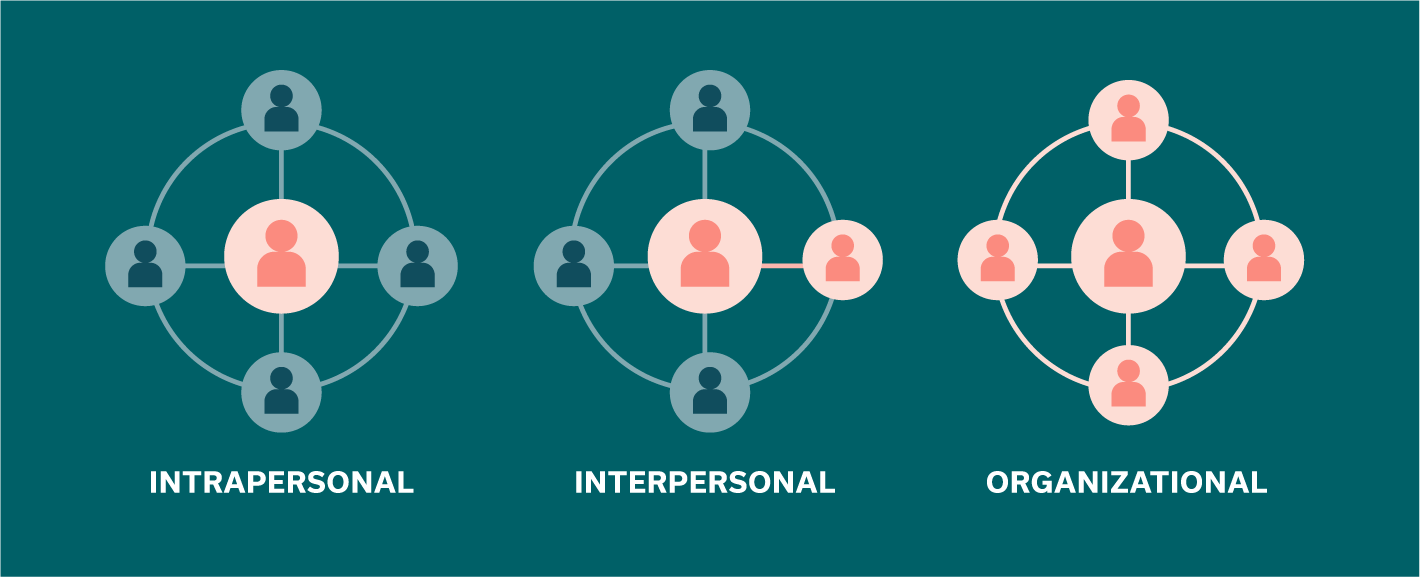
Organizational leadership requires navigating three distinct but interconnected relational domains. They build on each other, but for organizational leaders, the center of gravity needs to shift outward over time.
Intrapersonal — Your relationship with yourself
The foundation. This is self-awareness and self-management: knowing your triggers, values, strengths, and work style. Leaders need enough intrapersonal grounding that their patterns don't get in the way. But leaders who remain primarily focused here tend to center themselves in ways that limit their effectiveness at the organizational level. Being centered is the prerequisite for decentering. Once that foundation is built, continued growth comes from turning attention outward.
Interpersonal — How you relate with others
The building block of organizational effectiveness. At the organizational leadership level this isn't just being good with people. It's building real partnerships across competing interests and power dynamics, navigating conflict productively, and managing relationships up, across, and down simultaneously. The stakes and complexity are higher than at the functional level. The relationships organizational leaders build serve an organizational purpose, not just a personal or functional one.
Organizational — How you navigate groups and systems
Where much of the real work of organizational leadership happens. This is relationship work at scale: reading and navigating leadership team dynamics, understanding how different groups and functions interact, building partnerships across competing priorities, and seeing the system rather than just the individuals within it. This is the domain most leaders are least prepared for when they step into organizational roles.
The Developmental Shift
The ability to operate across all three domains, particularly the organizational level, is what distinguishes organizational leaders from functional leaders.
Functional leaders primarily operate at the intrapersonal and interpersonal levels. That matches the nature of their work. But as leaders move into Director, VP, and C-suite roles, the center of gravity needs to shift. Organizational leaders must have the intrapersonal foundation covered, their patterns largely managed and their self-awareness in service of the work, so they can focus primarily on interpersonal and organizational relationships.
Most leadership development focuses heavily on the intrapersonal domain and doesn't go far enough. Self-awareness is the building block but it's not the destination. For organizational leaders it's the starting point. The leaders who have the greatest impact at this level are those who have done enough intrapersonal work to get themselves out of the way, and who have developed real sophistication in how they navigate relationships and systems. That's where the leverage is.
Leaders who remain stuck at the intrapersonal level at senior levels don't just limit their own effectiveness. They create friction that others feel. Team members walk on eggshells, energy goes toward managing reactions rather than doing the work, and trust erodes. This is rarely intentional. But positional power amplifies everything, including where a leader's attention is focused.
Working With The Three Relational Domains Framework
Constellary uses this framework as a diagnostic in coaching and leadership team work. It helps leaders locate themselves, identify which domain they're operating in most, where they may be over- or under-investing, and where their development needs to go next.
In offsites and leadership team work it creates a shared language for the relational demands of organizational leadership, helping teams understand not just individual styles but the relational patterns shaping how they work together. It first came to life in the Leadership Archetypes Experience and continues to be a foundation for how Constellary approaches coaching, offsites, and organizational strategy work.
Want to explore how this framework applies to your exec team?