
Leadership Domains: Organizational Vs Functional Leadership
A Constellary Framework
Most leadership struggles aren't about capability. They're about leaders applying the wrong kind of work to the problem in front of them. As organizations grow, leadership work changes. Decisions no longer live inside a single function. Tradeoffs ripple across teams. What once required execution now requires integration.
The most important leadership distinction isn't between management and leadership — it's between functional leadership and organizational leadership, and whether leaders are operating at the right altitude for their role.
Why the Old Distinctions Aren't Working
We've been talking about the difference between management and leadership for decades. But that distinction has a significant blind spot — it assumes all leaders manage, and it collapses two very different kinds of leadership work into one category.
Not all organizational leaders manage people. And even those who do are being asked to do something fundamentally different at the organizational level — work that has nothing to do with managing a team and everything to do with navigating a system.
Despite years of conversation about leadership development, organizational leaders still routinely step into director, VP, and C-suite roles without knowing what the work actually requires. They don't have a clear picture of what good looks like at this level. They don't know whether they're doing it well. And the feedback they get rarely addresses what's actually getting in the way.
That's the gap this framework was built to fill.
To see how this paradigm breaks through traditional 20th-century definitions, read our side-by-side Management vs. Leadership vs. Leadership Domains Comparison Matrix.
How This Framework Came to Be
Our founder Suzan Bond kept seeing the same pattern in leadership teams she worked with. Leaders who were genuinely capable — smart, experienced, committed — were struggling in ways that didn’t make sense on paper. Directors who were overwhelmed by cross-functional complexity they’d never been prepared for. VPs who were still operating deep inside their function while organizational work went undone. Executive teams that felt busy but stuck. The feedback those leaders were getting was usually about style or trust or effort. But that wasn’t the real problem.
The real problem was altitude — leaders were doing the wrong kind of work for the role they were in, and no one had made that visible. I built this framework because I needed a way to name that pattern without it becoming personal. Once you can see where leadership work is actually landing, the conversation changes entirely.
Leadership work falls into two distinct domains. Understanding the difference is what allows strong functional leaders transform into organizational leaders. And, allows organizational leaders know when they should be in which domain.
Functional leadership work focuses on optimizing performance within a defined domain. It's execution-oriented, domain-specific, and closest to the work itself. When done well it creates consistency, predictability, and strong functional results. When applied beyond its domain it can unintentionally create silos or slow organizational progress.
Organizational leadership work focuses on optimizing the organization as a system. It's integration-oriented, system-aware, and longer-term in impact. When done well it creates alignment, momentum, and sustainable scale. When neglected, organizations experience friction and stalled growth — even when functional performance is strong.
The framework maps these two domains across two dimensions: the type of work being done and the role doing it. The result is four distinct zones — each representing a different combination of role and work type. What matters isn't which zone a leader is in — it's whether they're operating at the right altitude for their role.
The most persistent failure mode isn't leaders doing the wrong things. It's leaders doing the wrong kind of work for where they sit. When organizational leaders consistently operate in functional mode they become bottlenecks. Decision-making slows. Teams experience their involvement as micromanagement. Organizational work — alignment, integration, system-level thinking — goes undone. The organization feels this as drag rather than momentum.
This isn't a character flaw or a competence issue. It's an altitude problem — leaders working too close to the ground for the role they hold.
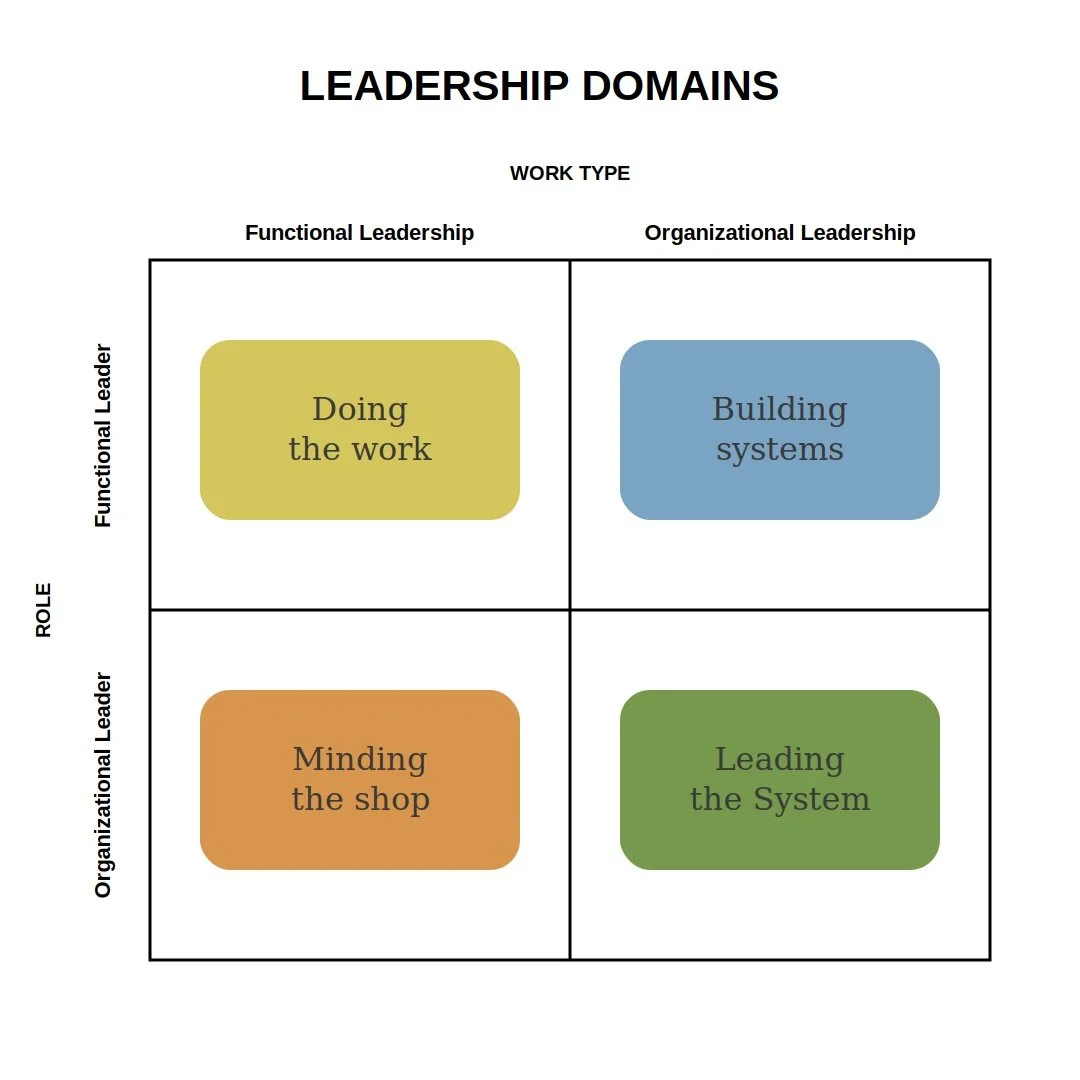
The Leadership Domains
Why the Gap Keeps Showing Up
The gap between functional and organizational leadership is wider than most organizations realize — and we keep underestimating it because we're using the wrong language to describe it.
The management versus leadership distinction doesn't capture what actually changes when someone moves into an organizational role. It's not just about managing differently or leading more. The work itself is fundamentally different — the problems, the relationships, the way success gets defined. And most leaders step into that new work without anyone marking the transition or naming what's now required of them.
Without language for the distinction, organizations can't set clear expectations. Leaders can't self-diagnose when they're operating at the wrong altitude. And the feedback they receive — usually about style, trust, or effort — addresses the symptoms without touching the cause.
The result is predictable. Leaders who were highly effective in functional roles struggle in organizational ones — not because they lack capability, but because they were never prepared for a fundamentally different kind of work. Teams lose trust. Organizations stall at critical growth moments. And the leaders themselves often can't understand why something that used to come naturally suddenly feels so hard.
This framework makes that transition visible — and gives leaders and organizations the language to navigate it intentionally.
Related Reading
Going deeper on Leadership Domains
Working With This Framework
Constellary uses the Leadership Domains framework as a diagnostic. The starting point isn't whether leaders are doing a good job — it's what kind of leadership work is actually happening and whether it matches what the organization needs right now.
In leadership team work, this framework surfaces patterns that are usually felt but rarely named — senior leaders spending most of their time deep in functional decisions, Directors overwhelmed by cross-functional complexity they were never prepared for, leadership teams stuck debating priorities instead of integrating them. Once the work maps where leadership is actually landing, these patterns stop being personal. They become structural. That shift alone changes the quality of the conversation.
Constellary uses this framework most in executive coaching, leadership transitions, and leadership team offsites — particularly when role clarity, decision-making, and altitude are at the center of what's getting in the way.
Ready to look at how this framework applies to your leadership team?