
Everything feels harder than it should
You've had the same conversation about the same problem three times this year
Leadership teams are polite in meetings, the real conversations happen after
Something's off but when you can’t quite name it to your board or your team
You've made the "right" moves, new hires, a reorg, more process, but there’s still friction
It feels like the team is on a treadmill, constantly running to hit goals
These pains are symptoms of unmanaged organizational debt.
That’s why everything feels harder than it should.
Imagine getting an outside read on your organization
Without carving out weeks for it or bringing in a big consulting engagement.
Knowing what's really driving the friction, instead of guessing or reacting to the most recent issue.
Knowing where to focus first, instead of feeling like everything needs fixing at once. Maybe the biggest thing: relief. You stop carrying the "something's off" feeling alone. Someone outside the org finally sees what you've been sensing, and can put words to it.
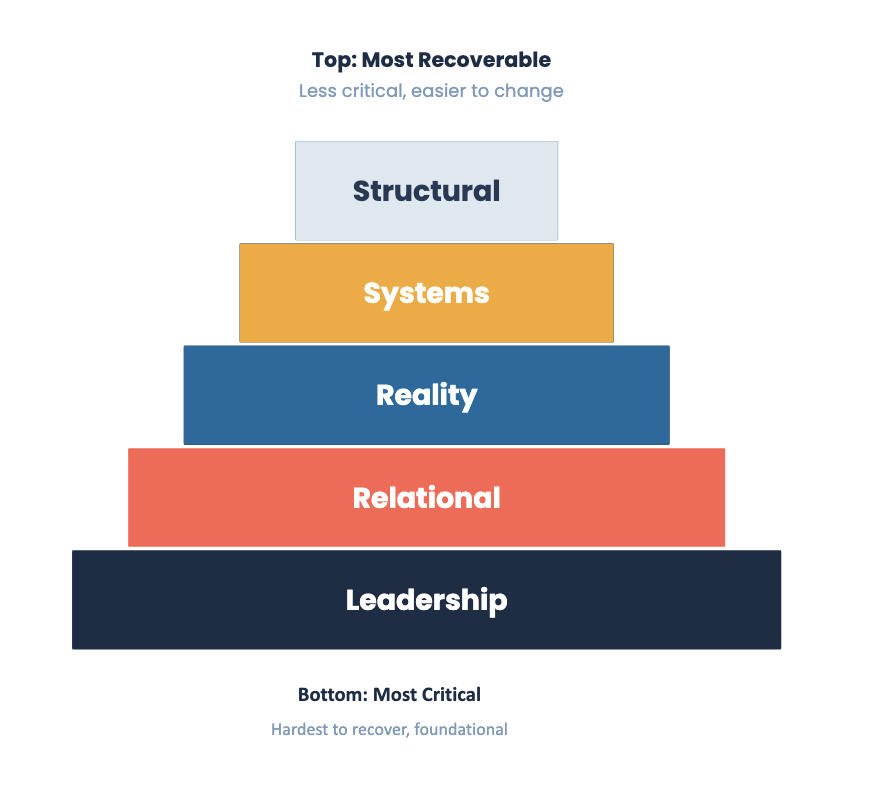
We’ve developed a framework outlining five kinds of organizational debt that weigh exec teams down and get in the way of results. We’ve created an audit to help catalogue and develop a plan to pay down this debt.
They don't all carry equal weight. We tend to reach for the ones at the top, visible and easy to point to. But starting at the bottom, with what's foundational, is where the real change happens.
The org debt hierarchy
How is this different from an employee engagement survey?
Engagement surveys have real value. They track sentiment over time. They can flag which teams are struggling. They point to what’s working.
But a survey score is a symptom, not a diagnosis. It tells you people are frustrated. It doesn't tell you if that's because of a leadership gap, a trust breakdown, an unrealistic workload, a broken process, or a structure that doesn't match how the org actually works anymore.
Even more sophisticated surveys are still surveys. They ask people more questions. They don't get anyone in a room to look at how the org actually operates.
You can't fix what you can't name.
The org debt audit tells you which one it is, and where to focus first.
The Organizational Debt Audit
The Org Debt Audit is a holistic diagnostic. Different roles see different sides of the organization and have different perspectives. That's why we talk with three people on your exec team: the CEO, the CHRO/People Leader and a third leader of your choice. it gives us a fuller picture of what's actually going on. Then a debrief, where we share what we're seeing and where it's coming from.
You'll leave with a named diagnosis, which debts have built up, how they're connected, and where to focus first, captured in a report you can bring to your board or your team.
What’s included:
1:1 interview with the CEO
1:1 interview with the CHRO/People Leader
1:1 interview with another leader of your choice
In-depth debrief session
A written org debt report
Suzan Bond first saw organizational debt firsthand as a COO, watching leadership strain, relational breakdown, and unrealistic planning quietly pile up while the org focused on growth. The framework grew out of that experience and the years since, working with hundreds of leaders and the executive teams they sit on. A certified executive coach and trained facilitator of 20 years, her clients have included leaders at Gymshark, Puppet, Griffin, StackHawk, and TaxBit, among many others.
Her background spans organizational strategy, leadership development, and relationship systems coaching, all in service of one thing: making the org work as hard for the business as the business is working for its goals.