
What is Organizational Debt
Maybe you’ve heard the term organizational debt and wondered, what is that exactly? It’s one of those things we say but we haven’t been precise about. After observing it for a long time and especially as a COO, I came up with my definition of org debt.
Organizational debt is the workarounds and unresolved gaps that accumulate as a company changes, creating obstacles to its goals. It shows up in five forms: leadership debt, relational debt, reality debt, systems debt and structural debt.
Organizational debt is the avoided conversations, the friction between teams no one talks about, the lack of clear expectations for leaders, the systems only a few people understand. It’s why we have long-standing conflict that never gets resolved. It’s why some teams can’t seem to work together. It’s why we worry about losing folks with institutional knowledge. It’s why our leadership team keeps changing out. It’s why the team is burning out.
Organizational debt is why everything feels harder than it should.
If you work in tech, you’ve probably heard of technical debt, the shortcuts in code that eventually slow everything down. Steve Blank, who coined the term organizational debt in 2015, saw it as tech debt’s people and culture equivalent. But while tech debt affects our product development, org debt affects our ability to execute anything at all.
What Fungi Taught Me About How Org Debt Spreads
I hadn’t thought much about fungus other than when it appears on toes or bread until I started reading Entangled Life: How Fungi Make Our Worlds, Change Our Minds & Shape Our Futures. Rather than disconnected entities, fungi are vast networks that live underground. They shape so much of the living world even when unseen. Author Merlin Sheldrake says, “We all live and breathe fungi thanks to the prolific abilities of fungal fruiting bodies to disperse spores.”
This could be a description of an organization. Every org has its own underground network, the interactions between people, and the systems and structures that keep it operating. Like fungi, org debt exists in every organizational entity. The workarounds and gaps of organizational debt aren’t just mechanical friction, they travel through that network, invisibly spreading out of sight beneath the daily grid.
This network is at work, invisibly shaping the culture, behavior and norms of the entity. It’s why we want to come to work, or not. It’s why everything feels hard or we feel like we’re moving smoothly together towards a goal like a high performance rowing team.
“A mycelial network is one large chemically sensitive membrane: A molecule can bind to a receptor anywhere on its surface and trigger a signaling cascade that alters fungal behavior,” says Sheldrake. A living organism like an org is similar. Sensitive, small changes can register far and wide especially in less resilient organizations that have gone through change. While a “spore” might start in one place, it doesn’t stay where it started. It travels across the entity, eventually embedding itself in small cracks and crevices.
In a fungal network, the mushroom is what we can see, underneath is a vast network at work. In organizations, our mushrooms are organizational smells, the first indication that something is wrong. Underneath, the debt is already spreading. By the time we can clearly see it—often as leadership, relational and reality debt—it’s begun to compound.
Small actions, especially when repetitive, in less resilient organizations ripple across the entity. On the surface, everything looks fine, for a while. But as these interactions pile up, they compound, profoundly altering the organism. Eventually they burst forth into view, most often as leadership and relational debt. At that point, the obstacles multiply.
Not All Org Debt is Equal
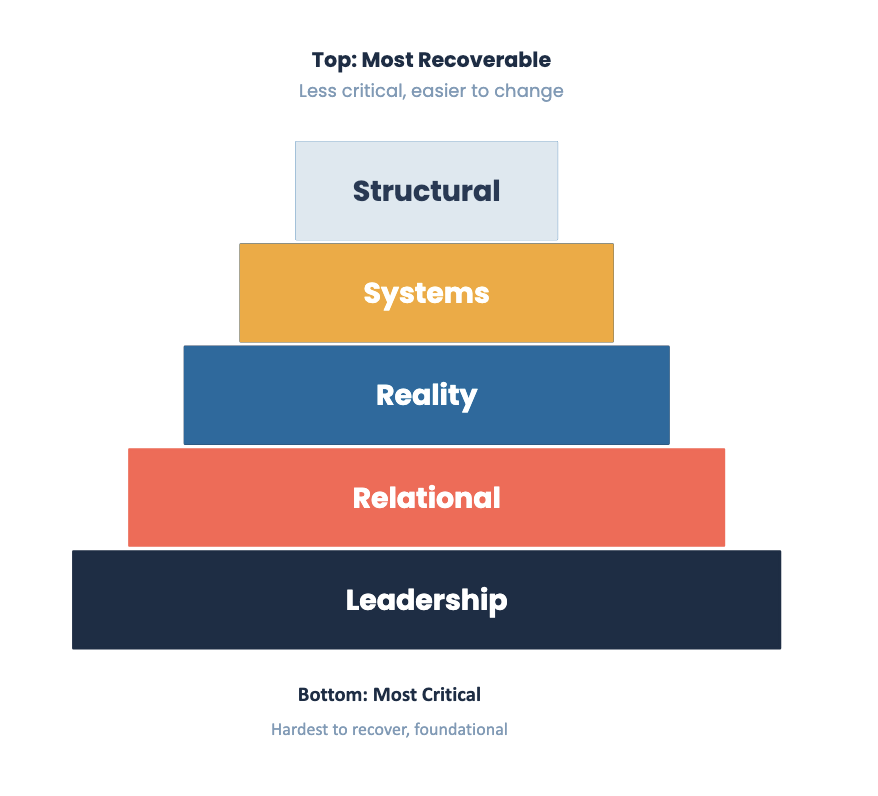
My five types aren’t just a taxonomy, there’s a hierarchy to them. Leadership and relational sit at the bottom because they are foundational to well-operating entities. They also tend to have the biggest blast radius and involve humans (who are deeply imperfect) at every level making them the hardest to recover from. Reality debt tends to follow these two and at the top of the hierarchy are systems and structural debt. Tangible and more readily seen, these are the two we tend to go after first but are the most recoverable and are often insufficient to dig us out of org debt.
Think of leadership and relational debt as the mycelium deep in the soil. Systems and structure are closer to the surface, easier to see and easier to reach. But picking the mushrooms doesn’t touch what’s growing underneath.
When the foundation (leadership) isn’t in healthy expression, it releases adaptive cultural “spores” that spread and in the process deform or corrupt any logical systems or structures we try to put on top of it. When the leadership layers aren’t functioning well, things can get off kilter between humans creating relational debt. These debts create fertile ground for reality debt to flourish. And yes, systems and structural debt soon follow until all five types are embedded in the entity, slowing down the company’s progress to goals and making it a not fun place to work.
Customer complaints rise, operations and engineering are at odds, decision making slows or decisions are remade over and over, senior leaders get pulled into ever more disagreements. Revenue is in jeopardy. The board is grumbling. What was once a hidden, subterranean systemic issue is now moving rapidly towards crisis.
A Real Life Example
Fungal networks? Invisible debts growing underneath the surface of a company? This probably sounds theoretical. You might be thinking, “Well maybe there are debts, but can they really impact a company so much that they threaten its well being?” Yes.
Let’s look at a real life example.
WeWork was a mid-2010s darling. At one point it was valued at $47 billion. Hundreds of articles written about it and its charismatic founder. Their name so synonymous with co-working you could almost use it like a verb.
By 2023 the company’s value was $45 million, a more than 1,000x drop and they were heading to bankruptcy. That’s like a $100 bill being worth less than a dime.
There have been plenty of stories about their debt-fueled spending spree and of course the impact of the pandemic which shuttered offices around the world. A collision between taking risks (debt-fueled growth) and a sudden macroeconomic event. Those are critical factors, but they’re the mushrooms of the organizational world, the part everyone could see. Underneath, there are others that contributed to their downfall—namely organizational factors. Plenty has been written about the founder’s charisma, hinting at a leadership problem but it’s more than that. When a founder (or any senior leader) creates a big enough gap between the company’s resources and its aspirations, you get reality debt. That reality debt helped topple the company is clear. My guess is that the assumptions they made, leading to the bets they made on the market and demand, depended on best case scenarios, with little tolerance for error. Financing growth through debt might be a good idea in an era of growth but also risky if you can’t make the turn fast enough. It looked like the bet paid off, until it didn’t. Reality debt also took hold by the founder seeing it as a tech company rather than what it was — a real estate company. The overhead of these models is quite different. For example, tech costs can more easily be shed, unlike a building or the traditional long leases of real estate, making them less nimble and responsive to market shifts.
How Leadership Debt Took Hold
This reality debt started somewhere else—with leadership debt, the bottom of the org debt hierarchy. Their strategy to become the undisputed leader in shared office space required debt-fueled growth while also guessing the right level of demand at the right time scale. This strategy was built of course by the founder, i.e. a leader. A strategy and execution plan built by a founder who took big swings, incurring massive amounts of risk with seemingly very few willing or able to question it in order to course correct. Was the founder really prepared for a hyper-aggressive strategy this audacious? The results seem to say no. For me, it’s a classic example of leadership debt.
Leadership debt is the accumulated cost of leadership capabilities, roles, and support structures that haven't kept pace with what the organization now requires.
Running a business valued at $20 million or even $500 million is quite different than a $47 billion behemoth with a complex and risky funding structure. Charisma can allow you to build a strong business but isn’t sufficient for that level of complexity.
The leadership debt was in some ways baked into its funding. While most founders get diluted with more raises, WeWork’s founder instead tightened his grip. While big funding rounds often introduce discipline like auditing committees and new board members, WeWork’s multi-class shares acted more like a shield for the founder.
The 2019 IPO filing revealed a three-class share structure which gave the founder majority voting control (despite owning a minority financial stake). This meant that even if the board voted him out, he could replace them. This also meant that the hiring and firing of key executives was likely entirely under the founder’s remit. These situations make it much more likely to hire folks who will do your bidding rather than push back. A structure like this without adequate (or really any) checks and balances is fertile ground, practically encouraging leadership debt to accrue.
And Relational Debt Grew
The leadership debt of the founder acted like spores that spread into the interactions between team members. Eventually it turned into relational debt as evidenced by a series of discrimination complaints and lawsuits starting in 2018, before the market and demand issues showed up. These kinds of legal issues are extremely costly financially — in lawyers’ fees and settlement costs — but also serve as a distraction from business priorities limiting revenue. Not to mention the costs of reputation damage control in publicists and what I can only imagine were countless meetings and conversations about PR strategy.
A series of legal disputes arising around conduct suggests a culture where negative behavior wasn’t checked before it turned toxic. Though I don’t know what it was like to be inside the company, these public records paint a picture of growing relational debt. A lack of behavioral standards that likely weren’t enforced. A lack of psychological safety and likely a siloed culture of competition rather than collaboration. When relational debt accrues, the org lacks the internal feedback loops that might help us see that we had reality debt and that it was coming due.
Then Systems and Structural Debt Followed
As leadership and relational debt fracture company culture, they spread spores to its systems and structures, hobbling its operations. Spectacular collapses like this almost always require all five types of organizational debt operating in tandem.
In 2019, they rebranded into The We Company and split into three branches: co-working, residential and education, creating a bloated corporate matrix. Structures like this require intentionality in operating agreements, decision rights and collaboration. Based on what came out later, this kind of operational clarity seems to have been missing.
Complex entities like this expanding their global footprint require strong operating systems. Seemingly adhering to tech’s “move fast and break things” motto, the company moved before the systems were in place at the appropriate scale. It appears many processes were done manually rather than through automated data infrastructure to manage locations across the globe. Siloed areas like legal, finance and real-estate operations likely added additional hurdles along with leases that may have been managed through fragmented, ad-hoc spreadsheets. This probably led to missed critical contract deadlines, accumulating additional cost and risk. Their systems debt wasn’t just a technical glitch, it was a financial trap.
When an organization’s structural framework and operational systems lag years behind its rapid growth, execution becomes a guessing game. By the time WeWork filed for bankruptcy, it wasn’t just crushed by market forces; it was suffocating under the collective weight of all five types of organizational debt.
And the spores of this collapse started with leadership debt.
The Living Network of Organizational Debt
What, then, is organizational debt? At its most benign, it is simply a byproduct of change—a natural signal of an organization’s shifting health. But if left unmanaged, the spores spread quietly beneath the surface, fracturing the culture, hampering the operations, and eventually damaging financial performance. At its most toxic, it hollows out an organization until it requires drastic, painful external intervention to survive.
In our real life example, WeWork survived its near-fatal implosion, forcing out its founder in 2019, then navigating a grueling bankruptcy restructuring in 2023 and finally stabilizing years later.
But the cost of paying down that accumulated debt was astronomical: tens of billions of dollars lost, thousands of layoffs, and destruction of its original identity.
Some may argue that this is an extraordinary example—that it isn’t applicable to you. It is extraordinary and it applies to everyday founders and CEOs. While our missteps may not lead to international news, our organizations are still at risk. The same silent network of debts can quietly choke a mid-sized business or a small startup just as effectively as it did a $47 billion giant.
Org debt is a living network, always operating beneath the surface of an entity. Once a company has passed a few years of existence, there will always be some amount of organizational debt. This is not always bad or detrimental. The key is making sure it’s known, intentional and there’s a plan for reducing or capping it.
Because when it isn’t, it becomes why everything feels harder than it should.
What to Read Next
Five Kinds of Organizational Debt: a deeper look at each type and how they compound
An Incomplete List of Org Smells: how to spot org debt before it surfaces
Lagom and Why Zero Organizational Debt is the Wrong Goal: how to manage org debt before it manages you
The Functional Rock Star Leader Myth: one of the most common sources of leadership debt