
Titles Are More Expensive than They Seem
I once worked for a company that handed out titles like candy to trick-or-treaters on Halloween.
Someone threatened to quit and a leader didn’t want them to leave? Give them a title. Someone wanted more money? Give them a title.
Titles were handed to leaders too, even when they weren’t ready. One time during a crunch a senior leader worried about missing goals promoted someone into a much bigger title and a seat on the exec team without any training or support. Things were ok, at first. Then they grew territorial about their function, refusing to collaborate with other leaders. Then a project they were leading fell into jeopardy, serious enough that people across the company had to step in to save it. Rather than take responsibility, they blamed their team and other leaders.
Tension rose on the exec team. It became obvious they weren’t performing. First they grew desperate. Then they shut down, their nervous system went offline. Afraid to show any weakness, they wore a mask even though it was obvious to everyone around them that something was wrong. They eventually left in a cloud of drama.
Titles feel cheap
I often hear the saying “titles are cheap,” and clearly, it was the ethos of my former company. I think when people say this, they mean it in terms of other compensation, like you can give someone a title and that will make them happy, or make them stay, or make them come into the organization.
The ever insightful Natalie Ledbetter recently wrote a LinkedIn post about this. She told the story of a founder who couldn’t change the compensation of a strong performer, so he gave them a VP title instead, hoping it would buy loyalty. It didn’t. The employee left a few months later, and left loudly. As Natalie wrote, “Titles are cheap. Trust is not. If you can’t pay for the level, don’t hand out the title.”
She’s right. That trade rarely works the way a founder or CEO hopes. And eroded trust is not cheap. It’s the foundation that people systems operate on. When trust is gone, the organization begins to accrue debt. It makes sense why a leader might reach for a title when it feels like there are other constraints. It happens all the time. And yet.
While titles might feel cheap, the wrong title at the wrong time for the wrong reason is extremely expensive.
Dropped in the deep end
Title inflation happens all the time. At some point we’ve probably all worked with someone who had a title they weren’t ready for. A title that doesn't fit the skill of an IC isn't great, but when it's a leader with a wider surface area, the trouble compounds.
Here’s what happens when a leader gets a title before they’re ready, often with insufficient leadership development support. It’s like dropping a new swimmer into the cold, deep end of the pool. Without a lifeguard, floaties or even a life preserver. Most often these unearned titles move them from functional to organizational leadership. These are completely different domains with vastly different required skills. This is what I call leadership domains or functional vs organizational leadership.
In unfamiliar territory, leaders with artificially inflated titles flounder. This takes their nervous system offline, whether they consciously know it or whether it's just sort of floating around their body. This makes it difficult, if not impossible to effectively lead at the organizational level.
Org debt accumulates
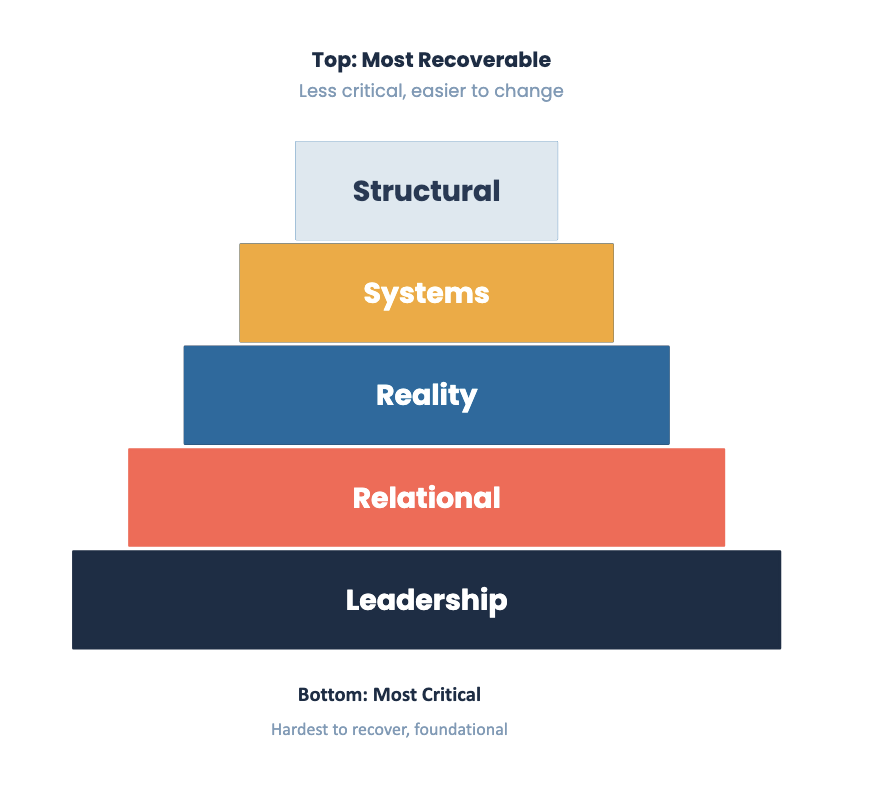
A few years ago, I developed a framework for organizational debt, the accumulated cost of shortcuts, avoidance, and misalignment that builds up inside a company over time, the way technical debt builds up in code. I’ve identified five types of org debt: leadership, relational, reality, systems, and structural. Here’s a hierarchy of how I see org debt from most critical to most recoverable. Leadership debt sits at the foundation because it’s the most critical and the hardest to recover from. Structural debt sits at the top as it’s less critical and easier to change.
When title inflation takes a leader’s nervous system offline, the top of the pyramid is affected less. The bottom three though — leadership, relational and reality debt — begin to build and compound each other creating friction making it more difficult to achieve goals. Here’s how an artificially inflated title builds debt in each of these areas.
Leadership debt
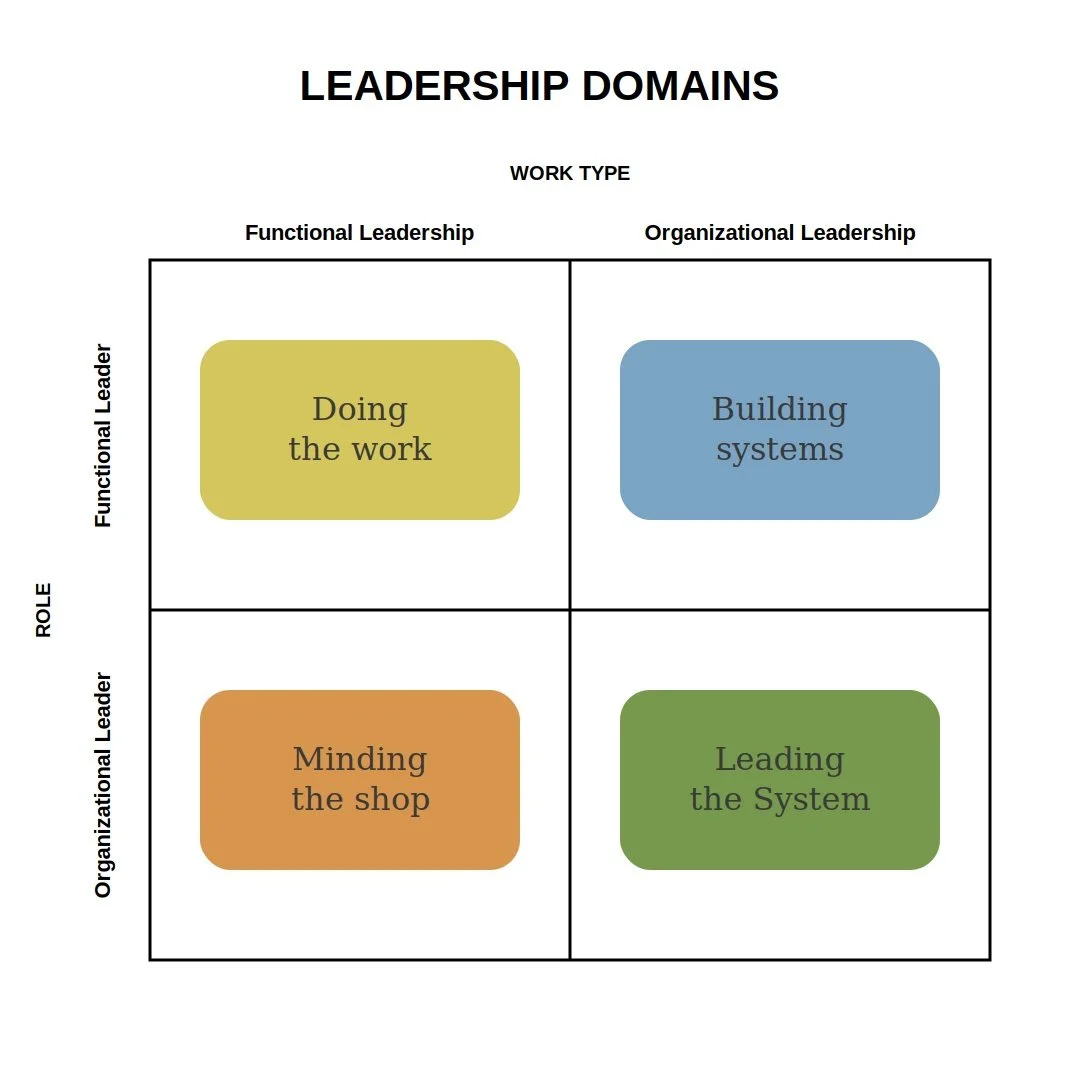
Leaders with unearned titles often operate functionally rather than organizationally. In my Leadership Domains model, Doing the Work is functional leaders handling day to day execution. Minding the Shop is an organizational leader doing functional work. Some amount of this work is normal though it shouldn’t be dominant. Leading the System is organizational leaders doing the cross functional, system level work. Org leaders should spend significant time in this quadrant.
These newly titled leaders spend too much time in Doing the Work, rather than moving between Minding the Shop when the moment calls for it, and Leading the System, where organizational leaders should spend most of their time.
Leaders with titles they aren’t ready for are operating at the wrong altitude. Overly involved in functional work, they can micromanage, creating bottlenecks. Afraid to make a mistake, they often take on too much deliverable work. They check, double check and even redo their team’s work. They fail to build capacity in their team. The important strategic and organizational initiatives or priorities get short shrift.
This is how leadership debt builds. Not from one bad decision, but from the daily costs of a leader working at the wrong altitude, redone work, stalled decisions, and strategic thinking that doesn’t happen because there’s no time for it. It engulfs the team. They stop doing their best work, it’s getting redone anyway. The team wonders if they’re adding value or whether they should find a new job, somewhere they can have an impact, grow and learn new skills. That’s leadership debt. Not a single failure, but a slow erosion of capacity from the promoted leader but also their team.
Relational debt
One of the biggest patterns I see in leaders with unearned titles? They have deficits in being able to navigate people systems. They focus on functional excellence and their team, failing to build necessary partnerships across the org. They might have pleasant relationships with other leaders but not the kind of robust ones needed to navigate the friction all orgs have. They don’t build the partnerships needed for Leading the System.
Many of these leaders also don’t feel confident in having difficult conversations so they avoid them while conflict quietly builds until it erupts, spreading the issue wider. Others handle conflict behind closed doors by getting others on their side rather than addressing friction directly. This builds an us vs them attitude which erodes trust and psychological safety. People start wondering if someone is gossiping about them or if they can take what people are saying at face value. This avoidance is like blowing on a dandelion, spreading weeds across the company, building relational debt pretty much everywhere
Leaders with titles they’re not prepared for also require significant energy from their boss who has to smooth over ruffled feathers because they don’t know how to navigate organizational dynamics or people systems. They spend hours trying to uplevel their people and influence skills. This takes tremendous energy, effort and time pulling the leader away from vital strategic initiatives. Yes, senior leaders will always need to mentor their upleveled folks but the gap here makes it far more arduous. If the new leader doesn’t get enough support or grow fast enough, the surface area grows wider. Eventually it reaches the attention of the exec team. Companies mired in relational debt aren’t winning any “best places to work” awards, likely have bad glassdoor reviews and are more likely to have rage quitting and burnout.
Reality debt
Leaders with artificially inflated titles still operating at the functional level think their value is in how much work they can ship. Prioritizing production pulls them deeper into the function rather than into the organizational layer. I once knew a leader who was promoted right before a big renewal cycle, when losing them felt like it could put the whole quarter's revenue at risk. The promoted leader felt the pressure to produce immediately. They felt like they could never say no because they constantly had to prove themselves. They thought delivering was pretty much the only thing that mattered. And, they had to produce more than last year, to keep up and to prove their worth. So, they signed up their team and the organization for work that they couldn't actually handle. Multiple people on the team burned out. One quit citing their leader. Others considered quitting too.
Leaders think when they’re giving a title that maybe someone isn’t ready for, they’re solving the problem: I’m going to reach this quarter or this year’s goals, because if they leave, the goals are in jeopardy. That’s the organization’s own reality debt showing up. The org pretending it can hit its numbers with unproven leadership rather than reckoning with the actual gap. The avoidance about what the org can actually accomplish combined with a leader who is equally out of step with what they can reasonably accomplish creates a massive amount of reality debt. The team feels like they’re on a treadmill, never able to catch a breath. Because they’re overburdened and under-resourced, they take short cuts and run behind, never getting a sense of accomplishment. This is not a place where people are excited to come to work.
Common title triggers
Title inflation is rarely the first crack in an org. It’s a surface indication that trouble is already growing underneath, in the foundation.
Title inflation doesn’t start organizational debt. It accelerates it.
These triggers usually show up when something unexpected and undesirable happens. External pressure in the market. A competitor ships faster than we can. Or we’ve been moving so fast, carrying so much reality debt, that we haven’t noticed one of our best people is unhappy and ready to leave. Whatever the cause, it’s a surprise. We feel like we have to solve it now, any way we can. The time scale we’re working from is now, maybe a couple of quarters out. Under pressure, caught off guard, our own nervous system offline, we make a decision for today without reckoning with what it costs tomorrow. We’re solving this quarter’s goals by hindering next year’s.
I’ll outline three of the most common triggers: budget, tenure and protecting goals.
Budget
We don't have the budget to compensate one of our best folks we're afraid will leave. So we reach into the title bag and pull one out for them. We hope that shiny new title will keep them at the organization longer. Something is better than nothing, right? What's the harm, we think?
We’ve heard a story about this already with the founder Natalie wrote about who, unable to increase a leader's compensation, reached into the title bag instead. This is a pretty familiar pattern, one most of us have seen whether we worked alongside someone in this position, been that person ourselves, or were the leader who felt like we had no other choice.
It’s an easy and common trigger. There’s less friction, conversation and chances for conflict than trying to get budget. As Natalie put it, “no board approval, no budget line, no hard conversation about the number.” Just a new title, and a hope that it’s enough.
Tenure
We have a workhorse who ships more than anyone else in the role. They carry years of institutional knowledge. Their functional expertise is rock solid. Even though their organizational skills are still sub-par, their ability to deliver can trigger senior leaders to give them the title anyway. They feel they owe them, for the loyalty, the tenure, and the sheer amount of work they do. We don't want to lose them — their output is valued and counted on.
The workhorse might also feel like they’re owed for their service to the company and for that functional expertise. They don’t realize the title is a different domain entirely, organizational, not functional. They don’t see the gap. This decision and lack of awareness build leadership and relational debt.
Getting a lot of things done or being at the company for a long time are not sufficient reasons for a promotion.
Protecting Goals
Sometimes it’s reactive. I knew a senior manager, leading work critical to the year’s goals, who was itching for a director title. They interviewed elsewhere, got an offer, more compensation and the title they wanted. They told their boss they didn’t really want to leave but the title was critical. Worried that losing them would put the goals in jeopardy, they were given the director title, despite the fact that they were deemed not ready during the latest performance cycle.
Other times it’s proactive. No outside offer, no threat, just a leader afraid of losing someone critical to the work, promoting ahead of a signal they’re truly ready. Either way, the title isn’t earned through readiness. It’s given out of fear of missing goals if they leave. Companies mired in reality debt tend to be more susceptible to this.
The Cost We Don’t See Coming
Titles are the easiest lever a leader has to pull. We can avoid the hard conversations on budget. Side step that awkward conversation when we have to point out the skill gap a leader can’t see yet. Avoid bringing up our ability to prioritize at the org level.
An IC with a title they haven’t grown into is a problem. A leader with one is an organizational problem, because a leader’s surface area is the whole organization. Their decisions touch other functions. Their behavior sets the tone for their team. Their capacity, or lack of it, pulls at their own boss’s time too. When a leader operates at the wrong altitude, the cost doesn’t stay contained to their function. It spreads.
This is organizational debt — the real cost of a title given too soon, for the wrong reason. The decision looks reasonable, even smart, at the time. The expense shows up later, in bottlenecks, in relationships eroding, in teams quietly burning out, in a senior leader working double time to manage a gap that got glossed over.
Org debt hits the leadership layer first, and leadership debt is the most critical, the hardest to recover from. So when we hand a title to someone who isn’t ready, we’re not making a small, contained bet. We’re adding weight to the foundation. Shaky foundations are tricky to build on.
This doesn’t have to be inevitable. A title given with real support, real assessment, and honesty about the gap doesn’t guarantee success, but it changes what the cost looks like.
Titles feel cheap to give. The debt they leave behind is not.
Find out what's underneath
When title inflation shows up, it's rarely the only one. The Org Debt Audit gives you a real diagnosis, not a survey score, of which debts have built up, how they're connected, and where to focus first. Book a free intro call to learn more.